
How in-house automation is raising the bar at Artemis Aerospace
By Pawel Asha, Quality Director at Artemis Aerospace
Processing thousands of aerospace parts involves more than moving stock from one place to another. Every part needs the right records, condition codes and documentation, with controls in place to prevent unserviceable components from re-entering the supply chain. At Artemis Aerospace, we have built our own automation to make these processes faster, more transparent and easier to control.
I guide that development myself, drawing on 20 years of running warehouse operations and quality control, alongside Adam Murray, our Operations Director. Off-the-shelf systems are a good place to start, but they do not allow for the specificity we want as a business. Extending the original application ourselves changed that: we can mine the data most useful to us, schedule automations, set up the notifications we want and make sure the aesthetics are to our standard.
A recent project illustrates the difference. We needed to scrap around 4,000 parts — a tightly controlled process involving physical mutilation, system write-offs, certificate generation, document uploads and updates to stock quantities and condition codes.
Handled manually, the same job means repetitive data entry, printing, signing, scanning and uploading a certificate for every part. That runs to around four months, and its accuracy rests entirely on people maintaining concentration across thousands of near-identical records. Our handheld scanners and automated processes brought it down to two weeks, with the checks built into the process rather than resting on the operator.
The reduction in processing time is substantial, but speed is only part of the benefit. We also capture a digital record of the whole process, with each stage visible on our dashboard. It is an example of how we are applying technology to the practical challenges of aerospace distribution, where efficiency goes hand in hand with quality and control.
Finding the right part, in the right place
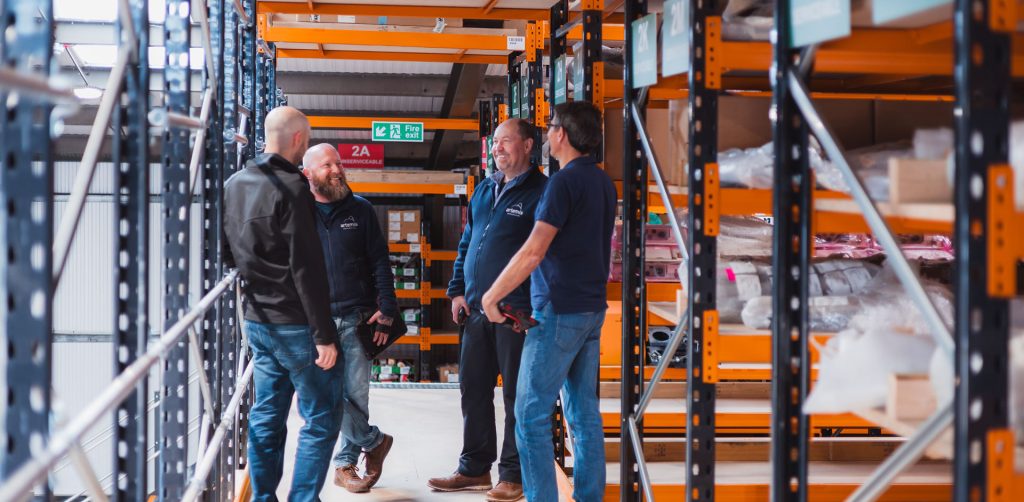
Accurate stock information is fundamental to an after-sales aerospace component supplier. When an item cannot be found where the system says it should be, time is lost investigating the discrepancy and the right part reaches the customer later than it should.
Our mobile scanning applications prevent errors rather than report them. When a part is put away, the scan checks the location against its condition code and will not accept a mismatch, so serviceable and unserviceable stock stays segregated and anything requiring quarantine cannot be shelved alongside saleable inventory.
Regular location audits provide a further check. We built a straightforward inventory audit app that scans the contents of a location, compares them against our records and surfaces any exceptions on the spot, so most can be corrected there and then. Where something does not match, we can trace the activity behind it — including everything else that operator received or put away — which usually leads us straight to the part.
Keeping compliance information accessible
Aerospace distribution depends on careful handling of approvals and certifications, and that information has to be accurate and to hand when it is needed. We actively manage Aviation Authority approvals and Quality Management accreditations across several thousand accounts.
We have brought all of it into one system, so there is a single source of truth where records were once held in several places. A central dashboard shows exceptions and items needing attention without anyone having to search across separate records. The system also scans for exceptions and anomalies daily, flagging them on the dashboard and emailing the people responsible, so issues surface rather than wait to be found.
The difference shows most clearly during audits. Since the new system went live we have undergone two audits and passed both with a 100% success rate. Auditors have asked for information and received it within seconds, with the supporting records readily available.
That level of visibility helps us meet our responsibilities consistently and demonstrate how our processes work.
Better information for better decisions
The benefits extend beyond warehouse activity and compliance. Automation has changed the management information available across the business. Bringing data together from different sources used to take weeks, and some of what we can now see simply was not available in a usable form.
We have live information across sales and quality. Sales performance indicators are reviewed weekly, giving managers a clear view of progress against targets and of what the following week needs to deliver. The system also calculates monthly and quarterly targets.
Quality controls work the same way. A rejection at receiving inspection is flagged automatically, so an investigation can begin straight away.
We now measure vendor turnaround times for repairs and supply. That tells us who performs and who does not, so we can place future work with the vendors who deliver – which directly improves the speed of the service we give our customers.
Having that information to hand makes it far easier to monitor performance and see where attention is needed.
Developing solutions
Our approach is to find the points in the operation where manual work, scattered information or unnecessary administration create difficulty, then build something practical around them.
The platform arrived with around 20 automated processes. We now run around 150 of our own on top of it — not replacements for what it does, but the things it was never going to do for a business like ours, built because no off-the-shelf configuration could have delivered them.
Development happens inside the business, drawing on our understanding of aerospace quality requirements, customer needs and day-to-day operations. Changes are tested in a separate environment before deployment, with documentation, performance monitoring and the ability to roll back where necessary.
One current project will let account managers upload customer certificates directly into the system when they set up an account. The relevant person is notified automatically that the documentation is ready for review, removing the need to send it separately by email. It is a small example, but it shows how a process can be improved without losing the controls it requires.
Technology that supports our customers
The value of automation lies in what it allows us to do better. By improving stock traceability, bringing compliance information together and making operational data more accessible, we are strengthening the processes that underpin our aerospace distribution service.
Our focus remains on giving aerospace customers the parts, documentation and reliable service they need, supported by systems that help us work efficiently and maintain rigorous quality control.
